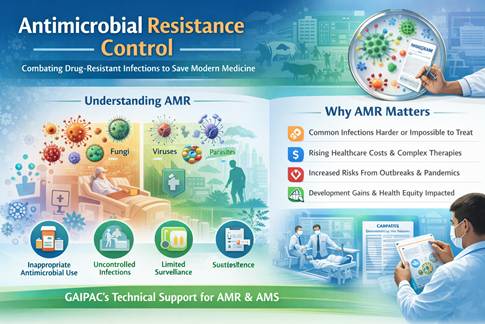
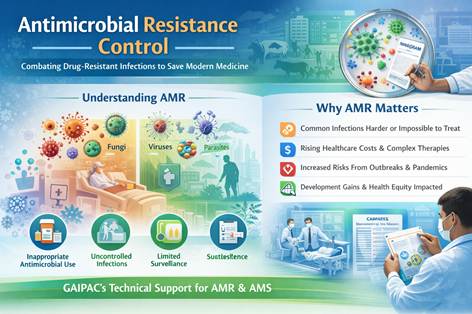
Antimicrobial Resistance (AMR) occurs when microorganisms such as bacteria, viruses, fungi, and parasites develop the ability to resist the effects of medicines designed to eliminate them. This leads to treatment failure, prolonged illness, higher healthcare costs, and increased mortality, undermining decades of progress in modern medicine.
AMR is driven by inappropriate antimicrobial use, weak infection prevention and control, limited surveillance, and poor integration across human, animal, and environmental health systems making it a critical One Health and global health security challenge.
Why AMR Matters
AMR threatens the effectiveness of essential medical procedures such as surgery, cancer care, dialysis, intensive care, and organ transplantation. Without urgent action:
- Common infections become harder or impossible to treat
- Healthcare costs rise due to longer hospital stays and complex therapies
- Health systems face increased risk during outbreaks and pandemics
- Development gains and health equity are severely impacted
Addressing AMR is therefore essential for patient safety, health system resilience, and global health security.
GAIPAC’s Technical Support in AMR & AMS
The Global Alliance for Infection Prevention & AMR Control (GAIPAC) supports countries and health systems to prevent, detect, and respond to AMR through integrated, evidence-based, and operationally feasible approaches.
1) Antimicrobial Stewardship (AMS) Program Development & Implementation
- Design and strengthening of facility and national AMS programs
- Development of governance structures, stewardship policies, and SOPs
- Implementation of prescribing guidelines, IV-to-oral conversion, formulary management, and audit-and-feedback systems
2) AMR & AMU Surveillance Systems
- Establishment and strengthening of AMR surveillance aligned with international standards
- Integration of laboratory and clinical data for actionable decision-making
- Support for surveillance of antimicrobial use (AMU) and antimicrobial consumption (AMC) at facility and national levels
3) Antibiogram Development & Use
- Support for routine facility and regional antibiogram development
- Training laboratories and clinicians on analysis, interpretation, and clinical use of antibiograms
- Linking antibiograms to treatment guidelines and stewardship decisions
4) Laboratory Systems & Diagnostics Support
- Strengthening microbiology laboratory capacity, quality assurance, and data management
- Supporting standardized testing methods and reporting
- Enhancing laboratory clinical collaboration to inform patient care and surveillance
5) Integrated Health Systems & One Health Approaches
- Integration of human, animal, and environmental health data for coordinated AMR response
- Support for cross-sectoral AMR coordination mechanisms
- Addressing drivers of resistance through waste management, environmental contamination control, and food safety
6) Capacity Building, Training & Leadership Development
- Competency-based AMS and AMR trainings for clinicians, pharmacists, microbiologists, and policymakers
- Leadership training for AMS committees and program managers
- Development of training curricula, tools, and digital learning platforms
Our Approach
GAIPAC focuses on practical stewardship that works—combining robust surveillance, clinical decision support, laboratory excellence, and system-level integration. By embedding AMR and AMS within IPC, quality improvement, and One Health frameworks, we help partners achieve measurable impact, sustainability, and improved patient outcomes.GAIPAC partners with governments, health systems, and development agencies to build strong, data-driven AMR and AMS programs that protect lives and preserve antimicrobials for future generations.