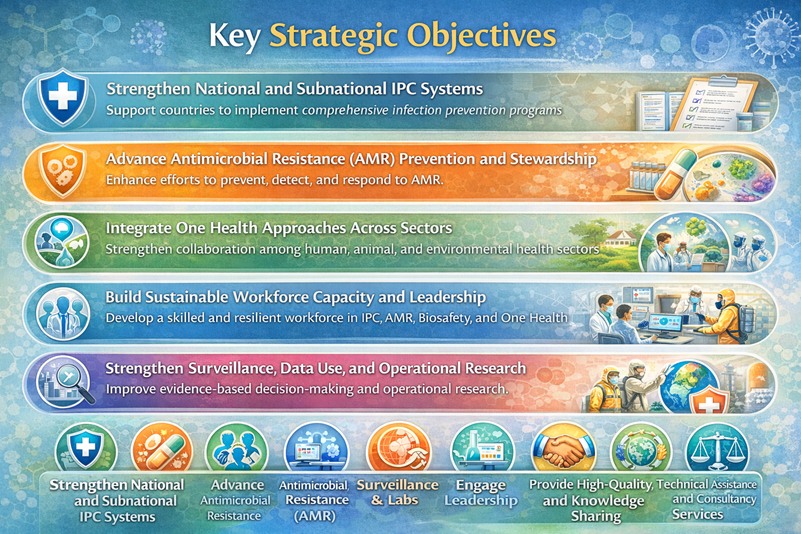
1. Strengthen National and Subnational IPC Systems
Support countries to design, implement, and institutionalize comprehensive Infection Prevention and Control (IPC) programs across healthcare and community settings by:
- Developing and updating IPC policies, guidelines, and standards
- Establishing IPC governance, coordination mechanisms, and accountability frameworks for the governments
- Supporting IPC implementation in acute care, primary care, laboratories, dialysis, long-term care, and community health settings
2. Advance Antimicrobial Resistance (AMR) Prevention and Stewardship
Enhance efforts to prevent, detect, and respond to AMR by:
- Supporting development and implementation of National Action Plans on AMR (NAP-AMR)
- Strengthening antimicrobial stewardship (AMS) programs across human and animal health sectors
- Promoting responsible antimicrobial use aligned with WHO AWaRe and international best practices
3. Integrate One Health Approaches Across Sectors
Operationalize One Health by strengthening collaboration among human, animal, and environmental health sectorsthrough:
- Joint IPC and AMR risk assessments and planning
- Cross-sectoral surveillance, information sharing, and response coordination
- Policies and interventions addressing healthcare waste management, water and sanitation, food safety, and environmental contamination
4. Build Sustainable Workforce Capacity and Leadership
Develop a skilled and resilient workforce by:
- Providing competency-based training, mentorship, and certification pathways in IPC, AMR, Biosafety, and One Health/GHS
- Strengthening institutional leadership, governance, and change management capacities
- Supporting pre-service and in-service education systems to institutionalize IPC and AMR competencies
5. Strengthen Surveillance, Data Use, and Operational Research
Improve evidence-based decision-making by:
- Supporting HAI and AMR surveillance systems, including laboratory clinical integration
- Promoting data quality, analysis, dashboards, and feedback mechanisms
- Conducting and supporting implementation research, cost-effectiveness studies, and impact evaluations
7. Provide High-Quality Technical Assistance and Consultancy Services
Deliver tailored, context-specific technical support by:
- Offering policy advisory, program design, implementation support, and independent evaluations
- Supporting governments, NGOs, donors, and private sector partners
- Ensuring services are evidence-based, ethical, and implementation-oriented
8. Foster Partnerships, Advocacy, and Knowledge Sharing
Strengthen collective action by:
- Building strategic partnerships with governments, academia, civil society, and international agencies
- Advocating for sustained investment in IPC and AMR
- Promoting knowledge exchange, south-south collaboration, and global learning platforms
9. Promote Equity, Quality, and Sustainability
Ensure all work:
- Improves quality and safety of care, especially in low-resource settings
- Addresses health inequities and vulnerable populations
- Supports long-term sustainability and country ownership