
Strong laboratory systems are fundamental to accurate diagnosis, effective IPC and AMS programs, AMR surveillance, outbreak detection, and global health security. Laboratories provide the evidence needed for clinical decision-making, public health action, and antimicrobial stewardship. Weak lab systems increase misdiagnosis, inappropriate antimicrobial use, occupational risks, and delayed responses to emerging threats.
GAIPAC’s Technical Support in Laboratory Systems Strengthening
The Global Alliance for Infection Prevention & AMR Control (GAIPAC) supports laboratories and health systems to build safe, high-quality, and integrated laboratory services aligned with international best practices and national priorities.
1) Biosafety & Biosecurity
- Development and implementation of biosafety and biosecurity policies, manuals, and SOPs
- Risk assessments and mitigation plans for handling, storage, transport, and disposal of biological agents
- Support for biosafety level (BSL) appropriate practices and staff protection
- Establishment of incident reporting, emergency response, and containment protocols
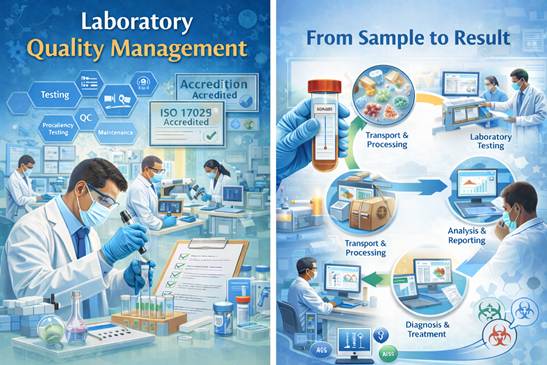
2) Laboratory Quality Management Systems (LQMS) & ISO Certification
- Design and implementation of Laboratory Quality Management Systems (LQMS)
- Stepwise support toward ISO 15189, ISO 17025, and related laboratory accreditation standards
- Internal audits, management reviews, document control, and continuous quality improvement
- Readiness assessments and mentorship for accreditation and certification
3) Equipment Management, Calibration & Certification
- Development of equipment management and maintenance programs
- Support for instrument calibration, verification, and performance qualification
- Biosafety cabinet (BSC) testing and certification in line with international safety standards
- Guidance on service contracts, documentation, and compliance tracking
4) Sampling, Testing & Diagnostic Guidance
- Development of standardized sampling, specimen collection, transport, and rejection criteria
- Technical guidance on testing algorithms, antimicrobial susceptibility testing (AST), and result reporting
- Harmonization of testing practices to support AMR surveillance and clinical care
5) Workforce Training & Competency Development
- Hands-on training in biosafety, quality management, diagnostics, and equipment use
- Competency assessments, refresher trainings, and mentorship for laboratory personnel
- Development of training curricula and job aids tailored to laboratory levels and functions
6) Laboratory Integration & Health System Linkages
- Integration of laboratory services with clinical care, IPC, AMS, and surveillance systems
- Strengthening laboratory information systems (LIS) and data interoperability
- Enhancing laboratory participation in national and regional surveillance networks
- Promoting cross-sectoral laboratory coordination under the One Health framework
Our Approach
GAIPAC emphasizes safety, quality, and functionality ensuring laboratories are not only equipped, but trusted, connected, and sustainable. By strengthening laboratory systems as part of broader IPC, AMR, and health security efforts, GAIPAC helps countries achieve reliable diagnostics, safer work environments, and stronger preparedness and response capacities.
GAIPAC partners with governments, laboratories, and development partners to build laboratory systems that meet international standards and deliver actionable results.